
The α-phe Risk Based Inspection (RBI) software is a digital solution designed to implement, manage, and sustain RBI studies in accordance with API 580 and API 581.
It enables organizations to move away from static spreadsheets and fragmented tools, and instead manage RBI as a living, auditable, and fully integrated digital process across the asset lifecycle.
α-phe RBI for Static Equipment Coverage
The α-phe Risk Based Inspection (RBI) software supports RBI assessments for static equipment component types in accordance with API 581 requirements.
It is designed to manage degradation, failure risk, and inspection planning across a wide range of pressure-containing equipment.
Static Equipment Component Types Covered
α-phe RBI supports API 581–based assessment for the following static equipment and components:
- Pressure vessels (shells, heads, nozzles)
- Piping systems and piping circuits
- Heat exchangers (shell side and tube side)
- Storage tanks (shells and bottoms, where applicable)
- Pressure relief devices (PRDs) – consequence and risk screening
- Associated static components subject to corrosion, cracking, or mechanical damage
This coverage enables consistent RBI assessments across entire facilities.
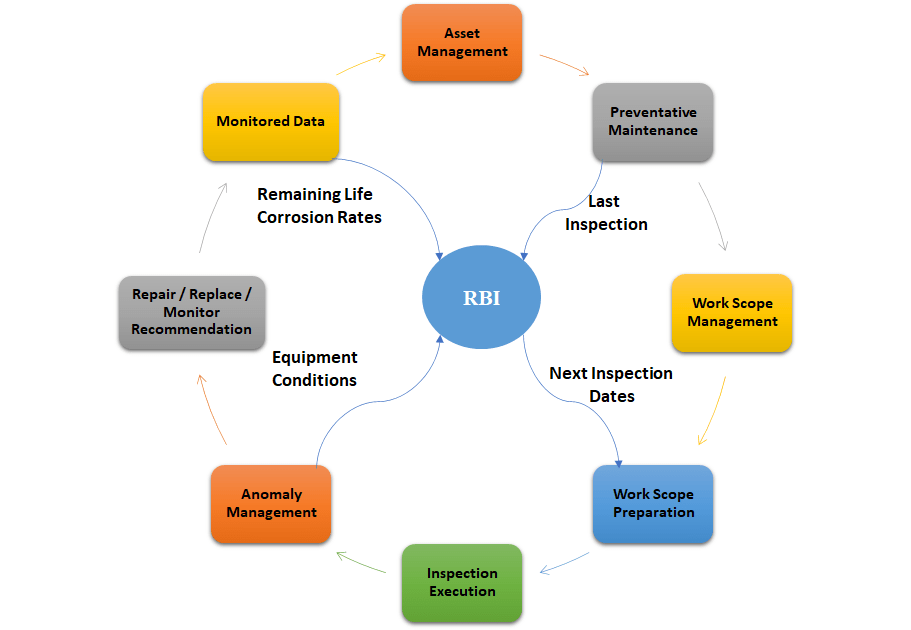
Continuous Improvement RBI Solution
Damage Modes Covered (As per API 581)
- Thinning (both general and local)
- Component lining damage
- External damage (thinning and cracking)
- Stress Corrosion Cracking (SCC)
- High Temperature Hydrogen Attack (HTHA)
- Mechanical fatigue (piping only)
- Brittle fracture
α-phe Risk-based inspection software is designed to help companies manage risk associated with equipment failure by identifying and prioritizing equipment for inspection and maintenance. Some of the functionalities typically included in RBI software are:
α-phe Risk Based Inspection (RBI) Software Capabilities
Centralized Equipment Database
The α-phe RBI software maintains a centralized equipment database that forms the foundation of all RBI activities.
It stores equipment type, location, design parameters, operating conditions, and historical inspection data in a single, structured system.
This ensures data consistency, traceability, and long-term sustainability of RBI studies.
Risk Assessment (PoF / CoF)
α-phe performs robust risk assessments by evaluating both the Probability of Failure (PoF) and Consequence of Failure (CoF) using API-aligned methodologies.
Risk calculations consider:
- Equipment age and service history
- Operating and process conditions
- Applicable damage mechanisms
- Safety, environmental, and business consequences
All assumptions and results are transparent, auditable, and repeatable.
Risk-Based Inspection Planning
Inspection plans are generated based on risk ranking, not fixed time intervals.
The platform enables users to:
- Define inspection intervals based on risk
- Select appropriate inspection techniques
- Optimize inspection scope and frequency
- Focus resources on high-risk equipment
This reduces inspection effort while maintaining safety and compliance.
Reporting and Risk Visibility
α-phe provides structured RBI reports and dashboards that clearly present:
- Equipment risk ranking and distribution
- Inspection plans and priorities
- Effectiveness of inspection strategies
This improves risk visibility and supports faster, better-informed decisions at both engineering and management levels.
Integration and End-to-End RBI Execution
The α-phe RBI module integrates seamlessly with CMMS and ERP systems such as SAP and IBM Maximo, ensuring inspection and maintenance activities are properly planned and executed.
It also integrates with other α-phe modules to deliver a fully connected Asset Integrity Management System (AIMS), linking:
- RBI assessments
- Inspection reporting
- Anomaly and damage tracking
- Maintenance and work scope planning
Continuous Improvement Through Digital RBI
α-phe enables RBI to be managed as a continuous improvement process, not a one-time study.
By embedding RBI within AIMS, the platform supports a structured Plan–Do–Check–Act (PDCA) cycle:
- Easy re-assessment using existing data
- Minimal effort for future RBI updates
- Continuous refinement of inspection strategies
- Improved asset reliability and performance
Through a fully integrated digital approach, Ankaa Consulting’s α-phe RBI software helps organizations overcome traditional RBI challenges and sustain effective, risk-based inspection programs across the asset lifecycle.
How Ankaa Consulting Supports Your RBI Journey
Ankaa Consulting provides a comprehensive range of services to support the full Risk Based Inspection (RBI) lifecycle, from data preparation to inspection planning and system integration.
Our services include:
- Asset Register Review and Alignment
Review and align asset registers to ensure consistency between RBI studies and CMMS systems such as SAP and IBM Maximo. - Centralized Mechanical and Process Data Management
Consolidate mechanical, design, and process data into a structured and traceable format to support reliable RBI assessments. - Consequence of Failure (CoF) Analysis
Perform qualitative and quantitative consequence assessments in line with API RBI methodologies. - Probability of Failure (PoF) Analysis
Evaluate likelihood of failure using applicable damage mechanisms and damage modes relevant to equipment and operating conditions. - Regulatory and Standards Compliance
Ensure RBI studies comply with all applicable governing codes, standards, and regulatory requirements. - Risk-Based Inspection and Maintenance Planning
Develop cost-effective inspection and maintenance programs based on risk ranking rather than fixed inspection intervals. - Corrosion Loop Definition and Analysis
Define corrosion loops by considering material selection and process conditions, and derive theoretical corrosion rates. - Inspection Data Review and Corrosion Rate Assessment
Review inspection reports and wall thickness measurements to calculate measured corrosion rates and remaining life. - Risk-Based Inspection Prioritization
Prioritize inspection activities by focusing on equipment and components with the highest risk exposure. - Corrosion Monitoring Location (CML) Definition
Define and manage Corrosion Monitoring Locations (CMLs) directly on piping isometrics. - CMMS Integration for Inspection Planning
Integrate RBI outputs with CMMS platforms such as SAP and IBM Maximo to generate and manage inspection schedules.
Bespoke RBI Solutions Beyond API 581
While API 581 provides a robust framework for many common damage mechanisms and metallic components, not all assets and operating conditions fall within its scope.
The α-phe Risk Based Inspection (RBI) software is designed with the flexibility to support bespoke RBI methodologies for scenarios not fully addressed by API 581.
Custom Damage Mechanisms and Inspection Strategies
α-phe enables the configuration and assessment of custom damage mechanisms, inspection logic, and risk calculations to address unique asset conditions.
This includes:
- Damage mechanisms not explicitly covered by API 581
- Site-specific or proprietary degradation models
- Emerging or atypical failure modes
- Client-specific inspection philosophies and risk criteria
Custom inspection plans, inspection intervals, and acceptance criteria can be defined and managed within the platform.
Coverage for Non-Metallic Components
In addition to metallic equipment, α-phe supports RBI assessments for non-metallic components, where API 581 applicability is limited.
Typical non-metallic components include:
- GRP / GRE piping systems
- Composite vessels and tanks
- Lined piping and vessels
For these components, bespoke degradation mechanisms, inspection techniques, and risk ranking logic can be configured to reflect actual failure behavior and service conditions.
Configurable and Scalable RBI Framework
α-phe is not a fixed, rule-based tool.
It provides a configurable RBI framework that allows organizations to:
- Extend RBI coverage beyond API 581
- Define custom component types and damage modes
- Apply alternative risk models (qualitative or semi-quantitative)
- Maintain consistency with internal engineering standards and corporate integrity philosophies
This ensures RBI remains practical, defensible, and aligned with real-world asset conditions.
Request for free Demo / Quote
Schedule a 30 minute to 1hr call
In the 30-minute to 1hr call we will demonstrate the software and explain the concept around RBI software, we will clarify all the queries you may have. The demo will be scheduled over Microsoft Teams. The link to connect will be provided after reviewing the submission of the request for free demo form below.